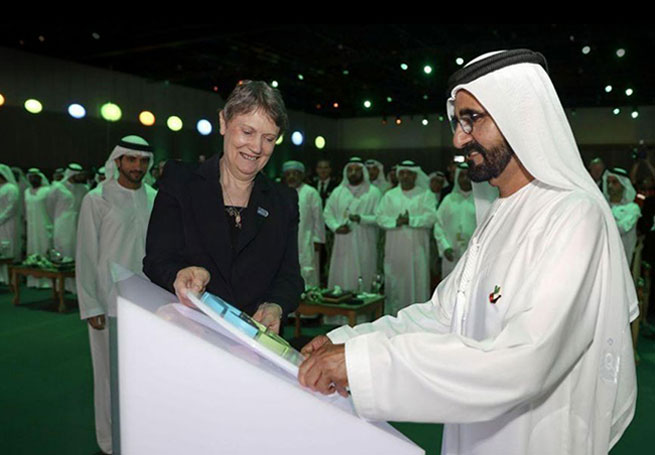
H.H. Sheikh Mohammed bin Rashid Al Maktoum Launching WGEO

ABOUT World Green Economy Organization

The World Green Economy Organization (WGEO) is a comprehensive response to calls by the international community for a holistic approach to spur progress on how and why a green economy is the world’s best route towards a safe and prosperous future.

The path from the Rio+20 United Nations Conference on Sustainable Development in 2012 to the passage of the new 2030 Agenda for Sustainable Development and the Paris Agreement, has seen strong levels of commitment by world leaders to shift to a green economy.

WGEO seeks to promote the widespread acceptance and increased importance of green economy in the context of Sustainable Development and poverty eradication.

WGEO intends to support emerging global actions towards the green, low-carbon, climate resilient development model. The organization is framed to operationalize green economy concepts on the ground through results and impact-oriented action.
The World Green Economy Organization (WGEO) is head quartered in Dubai, United Arab Emirates.

"Shifting towards a greener economy provides greater opportunities for governments, investors and businesses at the same time addresses environmental sustainability and economic growth challenges."
H.E. Saeed Mohammed Al Tayer,
Chairman, World Green Economy Organization (WGEO)
Vision

Be the leading source of knowledge, innovation, technology, finance, capacity building and other enabling elements of green economy growth and expansion & to operationalize this leadership role through the facilitation of partnerships between the public and private sectors, as well as with and among other relevant stakeholders working towards increasing the reach of and the effective adoption of green economy principles and practices across the world.

Mission

Promote the widespread adoption of green economy principles and practices within the context of sustainable development and poverty eradication, with the primary focus being sustaining economic growth, enhancing social inclusion, improving human welfare and creating employment opportunities while maintaining and nurturing the planet's ecosystems and mitigating the damaging impacts of environmental degradation on human health and welfare.

Mandate

A multi-stakeholder organization, as reflected in its governance structure, WGEO serves as the premier platform for international cooperation between State Members and Platform Members (Public Sector, Private Sector, Civil Society, Academia and Youth, Cities, Financial Institutions and International Organizations) to come together in concerted effort towards promoting the green economy agenda to enable and implement bankable and sustainable green projects and programs in the areas of energy, water and infrastructure by linking technology, capacity building and finance.

Objectives
  • Access to technical & financial assistance
  • Transfer of knowledge,technology and greeneconomy tools
  • Dialogue on green economy policies, strategies & methodologies
  • Capacity Building
  • Creation of employment opportunities
We aim to find long term solutions that address the challenges in line with the United Nations Sustainable Development Goals 2030, and the transition to green economy to ensure a sustainable future for us and generations to come.
Waleed Bin Salman
Vice Chairman, World Green Economy Organization (WGEO)

Governance

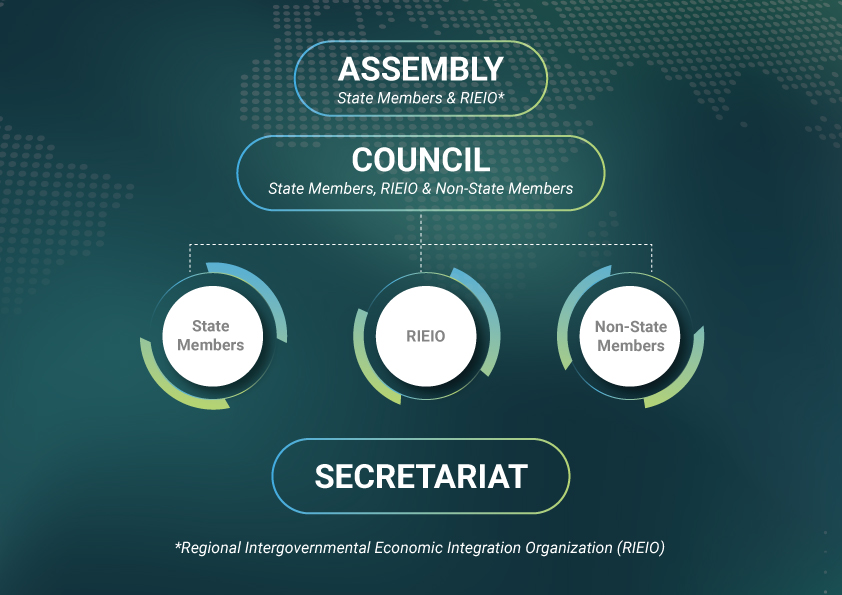
WGEO established with an innovative organizational and institutional structure employing innovative operating procedures. WGEO members including the non-state members are accorded a voice in decision-making processes.

The organization comprises of a three-tier structure the Assembly, the Council and the Secretariat. The Assembly is composed of State Members and RIEIOs. Non-state Members of WGEO may be represented in the Council.

The Secretariat is responsible for the day-to-day operations of the organization, and for providing administrative, legal and financial support to WGEO activities.

Read More
I am convinced that we can move forward with confidence for the green economy and the benefits of the Fourth Industrial Revolution
Antonio Guterres
Secretary General, United Nations

The purpose

The purpose of WGEO is to provide systematic and holistic catalytic support to the promotion of the green economy. WGEO will support efficient and effective implementation of innovative programs and projects, facilitate technology transfer and policy dialogue and norm-setting facilitating investments in the green economy, and support mobilization of financial resources, technical assistance and capacity building.

The objectives of WGEO are, int. al.:

To promote the widespread acceptance and increased importance of the green economy in the context of sustainable development and poverty eradication and facilitate investments in the green economy, by linking financing, technology, capacity-building and all other elements of the enabling environment for the green economy;

To serve as a platform for international cooperation and knowledge-sharing between developed and developing countries, the public and the private sectors, international organizations and all other key stakeholders, aiming to promote implementation of green economy policies at all levels, in a manner that endeavors to drive sustained, inclusive and equitable economic growth and job creation, particularly for women, youth and the poor;

To support, through technical and technological assistance, the efforts of developing countries that choose to implement green economy policies in the context of sustainable development and poverty eradication.

We know we must get on board as many stakeholders and key players as soon as possible. The Green Economy offers a compelling plan of action to secure our future and transform our economies and societies for the better
AbdulRahim Sultan
Director General, World Green Economy Organization (WGEO)

Activities

As an action-oriented organization, facilitate or participate in a wide range of financial and operational instruments, including innovative instruments specific to the green economy, as may be required for the fulfillment of WGEO’s objectives and for any other relevant purposes;

Provide to its Members, upon their request, advice on the financing for the green economy and support the application of related mechanisms;

Initiate, facilitate, and, where necessary, coordinate and implement green economy programs, projects and technical assistance initiatives aimed at promoting the adoption of the green economy, and other relevant projects and initiatives;

Help mobilize funding and leverage resources for green economy programs and projects, invest funds in projects of various nature and scale, as well as in technical assistance initiatives aimed at promoting the adoption of green economy projects and initiatives;

As a hub of information on all aspects of the green economy, promote and help coordinate, with the support of advanced information technology, the collection and dissemination of information regarding the green economy, and undertake any other measures required to increase public awareness on the benefits and potential offered by the green economy model;

In the context of its operational activities, analyze, monitor, and systematize current green economy practices, including policy instruments, incentives, investment mechanisms, best practices, available technologies, and success-failure factors;

As a result-oriented cooperation framework for a wide range of stakeholders, initiate, facilitate, and, where necessary, coordinate discussion and ensure ongoing results-oriented policy dialogue between all the stakeholders in the field of the green economy;

Provide relevant result-oriented policy advice, facilitation and assistance to its Members upon their request, considering their respective needs, and stimulate international dialogue on the green economy;

Facilitate pertinent knowledge and technology transfer, including through south-south cooperation, and promote the development of local capacity and competence among its Members, including necessary interconnections;

Serve as a trusted source of information and expertise in the field of the green economy;

Stimulate, facilitate and encourage result-oriented research on the green economy, including on its socioeconomic aspects, facilitate innovation, and foster research networks, joint research, development and deployment of technologies;

Offer technical assistance, capacity building covering training, education, and any other capacity building activities to its Members and other stakeholders; and

Engage in such activities as may be required to accomplish its objectives.

Platforms

Platforms are the key mechanism for the implementation of WGEO’s activities, they operate as a framework for the cooperation and collaboration between State Members and Platform Members. Each platform is led by a specific type of stakeholder. Seven groups of stakeholders and seven platforms were initially identified.

WGEO Global Outreach and Regional Coordination

Recognizing the crucial role regional collaboration has to play in achieving the transition to green economies, WGEO is transforming regional engagement through a unique modality of operations. WGEO leverages the regional network offered by the five UN Climate Change Regional Collaboration Centres (RCCs) located in Bangkok, Kampala, Lomé, Panama and St. George’s, to support the facilitation of regional coordination on green economy principles and practices by the deployment of experts at each RCC. These experts are instrumental to aligning regional activities with the global green economy agenda.